
What is SEO? A Beginner’s Guide to Search Engine Optimization
Have you ever wondered why some businesses show up everywhere online on Google search engine, Social media, LinkedIn, and whatnot, while others barely get noticed?
You may have a great product or a service that people really need, but if you are not on the SERPs (search engine result pages), none of your other efforts matter.
But if you know how search engines work, you’re in the game.
We’re here to help you understand everything about Search Engine Optimization and how artificial intelligence in digital marketing is taking centre stage. Knowing these will help you learn how to leverage SEO to drive traffic and generate revenue.
What is Search Engine Optimization (SEO)?
Search Engine Optimization, or SEO, is the process of improving your website so that search engines can understand what it’s about and recommend it to the right people. In other words, when someone searches for topics relevant to your business, services, or knowledge, SEO helps your page to appear in front of them without needing to pay for ads.
When your page ranks higher on search engine result pages (SERPs), it naturally attracts the qualified traffic who are searching for what you offer. Which means you get more visibility, more trust, and more consistent traffic over time. Many beginners think SEO is just a marketing tactic. But it’s the core of creating your online presence in the long term.
Modern SEO goes far beyond keywords and links. Search engines now focus on understanding the meaning, relevance, and user intent. Google’s search engine uses AI-powered search features, semantic understanding, and behavior signals to determine how your content will get ranked.
SEO for beginners becomes easy if you understand it through Mozlow’s Hierarchy of SEO needs, created by Rand Fishkin, co-founder of Moz. Similar to the original Maslow’s Hierarchy of Needs pyramid, it outlines how people should implement SEO.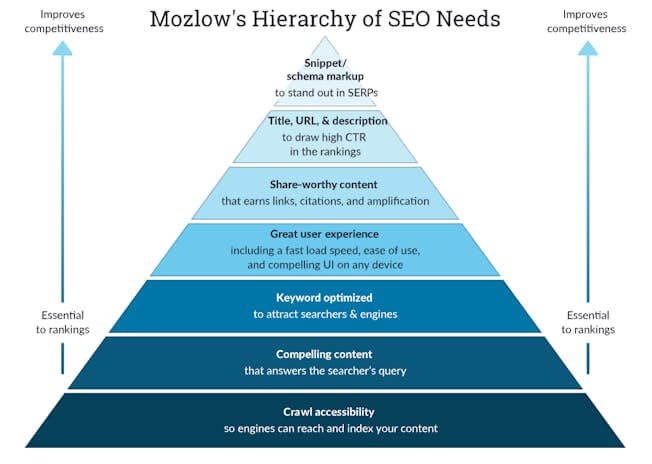
How Search Engines Work?
It may be confusing to think about how search engines work to rank websites. But it’s definitely not luck. They follow a strict system to find the content, understand it, and then decide which page should be shown to the people searching.
The process comes down to three steps:
Crawling
Search engine crawlers are like digital crawlers that hop from link to link, scanning pages, and looking for new content to add to their system. With strong SEO, your job is to make their path as smooth as possible. Here’s how to do it:
- Keep your pages connected with internal links
- Create an XML sitemap so bots know what to look at
- Refresh content so your site looks active
- Fix broken links and crawl issues in Google Search Console
If search engines can’t move easily around your website, your pages won’t show up in search results.
Indexing
Now that your content is discovered by crawlers, search engines store it in their index so they can pull it up later when needed. An index is basically a giant digital library of web pages. To help search engines properly index your web pages, you need to:
- Use clear headings and meaningful keywords
- Write descriptive meta tags and alt text for images
- Avoid duplicate or confusing content
- Keep an eye on index reports inside Google Search Console
If your page doesn’t get indexed, it’s pretty much dead.
Ranking
This is the step where things get competitive. After your page is indexed, search engines decide where it should appear when someone searches for something you cover. They consider Google ranking factors like relevance, quality, trust, and user experience of your site.
Here’s how you can boost your chances of ranking higher:
- Create genuinely helpful content that answers people’s questions
- Make your site fast and mobile-friendly
- Earn backlinks from trustworthy, relevant sites
- Track your progress with tools like Google Analytics and Search Console.
The more relevant content you create for users, the better your chances will be to climb the Search engine ranking.
Difference Between SEO, SEM, and PPC?
As you jump into search marketing, you’ll come across three key terms: SEO, SEM, and PPC. You must know how they relate to create a good SEO strategy that works.
SEO vs. SEM
Search Engine Marketing (SEM) is a broader term that covers both Search Engine Optimization (SEO) and Pay-Per-Click (PPC) advertising. SEM refers to all efforts you use to increase your visibility and ranking on Google and other search engines, no matter earned or paid.
In beginner language:
- SEO means earning organic visibility through relevant, high-quality content and website optimization.
- SEM includes both organic and paid search strategies, and therefore combines SEO and PPC to drive traffic.
You can think of SEM as the full search strategy that uses SEO and PPC as two complementary components to achieve greater reach.
SEO vs. PPC
Pay-Per-Click, aka PPC, is a strategy where advertisers pay a fee each time someone clicks on their ad. PPC campaigns help the brands to appear on top of Search Engine Result Pages by bidding on the high-performing keywords. Which means they can get faster visibility for targeted terms.
You must have heard of Paid search vs. organic search. PPC refers to paid search, while SEO refers to organic search. The key differences between the two terms are as follows:
Factor | Organic Search (SEO) | Paid Search (PPC) |
Position | Organic results appear below paid placements | Ads appear at the top of search results |
Time to Results | Growth occurs over weeks or months; long-term play | Immediate visibility when campaigns run |
Cost Model | No cost per click, but requires time and resources | Pay-per-click (CPC) |
ROI Pattern | Harder to measure initially, typically improves long-term | Easier to measure short-term ROI, but can plateau |
Traffic Share | Approximately 53% of all website traffic | Around 15% of clicks |
Both SEO and PPC require keyword research, an effective landing page strategy, and a search intent plan. Although paid search can provide speed and more control, organic search delivers more sustainable results that compound over time.
Why is SEO important?
SEO is one of the most powerful and sustainable digital marketing channels, especially in 2026, since search behaviour continuously expands across platforms. Although people are using AI overviews and Large Language Models (LLMs) for their searches today, search engines remain the primary starting point for online research.
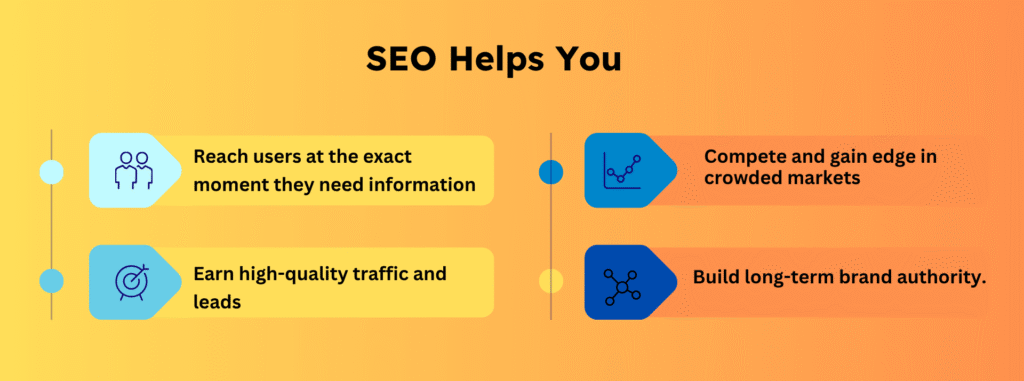
Google handles over 9.1 billion searches per day, and organic searches drive more than half of all website traffic. If your page ticks all the search engine ranking factors, you earn steady and qualified traffic even without paying for each click. You naturally become an authority in your industry.
Search is intent-driven because people are looking for answers, products, or services. If your SEO gives them what they are looking for, search engines become your highest conversion channels. With strong SEO, you can build lasting visibility, trust, and authority, which helps you stay discoverable even as search engine algorithms evolve.
However, Search today goes beyond Google. Your audience is searching on YouTube, Amazon, TikTok, Instagram, LinkedIn, and emerging AI-powered search tools like ChatGPT or Jasper AI. Therefore, you need to be present across all search surfaces to ensure your credibility and visibility.
What Are the Types of SEO?
Modern SEO is built around 3 core pillars. Each plays a crucial role in helping your website rank higher and remain competitive in today’s search results, including AI overviews, mobile-first indexing, and multi-platform discovery. The 3 core pillars include:
Technical SEO
Technical SEO is the most important part to help search engine crawlers crawl, understand, and index your website efficiently.
Best Technical SEO Strategies include:
- Site architecture and crawlability
- Core Web Vitals optimization (speed, responsiveness, stability)
- Mobile-first and cross-device performance
- Structured data/schema markup for AI-enhanced search results and rich snippets
- Indexing controls through sitemaps, robots.txt, and canonical tags
- HTTPS security and safe browsing standards
Technical SEO now also supports AI search readiness, meaning clear page context, structured entities, and fast, seamless performance across devices.
On Page SEO
On-page SEO refers to the SEO strategy that focuses on your website’s individual pages so that search engines can understand them clearly and users can engage with them easily.
On-Page SEO Strategy Includes:
Keyword and Search intent alignment: Use of relevant terms naturally in the titles, headings, and content to answer user needs.
Metadata optimization: Use compelling title tags and meta descriptions to improve click-through rates.
High Quality, original Content: Create helpful, reliable, and people-first content that provides trustworthy information according to user intent and provides your experience.
Multimedia Optimization: Use images, video, and interactive elements while ensuring their proper alt text and compression.
Internal Linking: Connect relevant pages to help search engines understand the structure and authority.
Clean URL structure: Use clear and descriptive URLs that define the topic of each page.
In 2025 and 26, the on-page SEO prioritizes experience signals. Search engines love the pages that demonstrate E-E-A-T (Experience, Expertise, Authoritativeness, Trustworthiness).
Off-Page SEO
Where On-page SEO builds authority and trust on your website, Off-page SEO expands your brand presence beyond your website.
Core Off-Page Strategy includes:
- Earning high-quality backlinks from reputable websites
- Digital PR and influencer collaboration to build awareness and authority
- Brand mentions and citations, even unlinked, to strengthen credibility
- Social visibility and engagement to support brand signals
- Local SEO practices when targeting geographic audiences
Unlike previous decades, hundreds of backlinks don’t provide good off-page SEO. Using white hat link building to produce authority and quality backlinks is crucial now. A strong backlink strategy and link profile boost your brand strength and digital reputation across the web, including all social media platforms, topical communities, as well as AI-powered search results.
SEO Specialities
Beyond core SEO, several specialized fields focus on unique website structures, goals, and audiences. These SEO branches require additional tactics and often come with distinct technical or strategic challenges.
Local SEO
Local SEO focuses on improving visibility in location-based searches. Key considerations include:
- Google Business Profile optimization
- Local business citations
- Review management
- Local content and landing pages
Local SEO is crucial if your business is serving a defined geographic area, including retail, hospitality, services, and healthcare.
Ecommerce SEO
Ecommerce SEO focuses mainly on optimizing online stores. Key considerations include:
- Category and product page optimization
- Faceted navigation management
- High-quality product descriptions and reviews
- Strong internal linking for product discovery
- Image and video optimization
- Product-focused schema and structured data
Your ecommerce success depends on balancing user experience, conversion strategy, and search visibility across large product catalogs.
Enterprise SEO
This applies SEO at a massive scale, often for organizations with millions of URLs, multiple business units, or high global traffic. Key Challenges include:
- Complex site architectures
- Slower implementation due to layered approvals
- Cross-team collaboration (SEO, dev, product, legal, brand)
- Advanced automation and reporting systems
Enterprise SEO requires strategic governance, scalable solutions, and efficient workflow management.
International SEO
It supports brands that operate across multiple languages and regions. It involves:
- Hreflang implementation
- Country-specific content and keyword targeting
- Localization of UX, pricing, and cultural elements
- Optimization for regional search engines (e.g., Baidu, Naver, Yahoo Japan)
The goal of International SEO is to provide accurate, localized content and ensure search engines serve the right version to the right audience.
News & Publisher SEO
News & Publisher SEO is designed for fast-moving content environments. Priorities include:
- Rapid indexing and crawling
- Eligibility for Top Stories, Google News, and Discover
- News-specific schema markup
- Managing paywalls and content freshness
Publishers must balance technical accuracy, content speed, and trust signals to remain competitive.
Key Google Ranking Factors
Google doesn’t like keyword stuffing or clever hacks. If you’re still using those, a single Google update is all it takes to drop your website ranking and trust. In 2025, ranking high requires you to build trust by offering value and creating an experience that people need. Understand what search engine ranking factors move the needle now:
E-E-A-T and Content Quality
Google’s E-E-A-T stands for Experience, Expertise, Authority, Trust. It means to show the search engines that your content is the real deal, not a copy of what others are saying. You don’t need any fancy credentials to prove your expertise, but including some proof of how you’ve done what you talk about is what matters.
Here’s how you can show it naturally:
- Add first-hand insights, screenshots, and real steps you’ve tested
- Share personal results or real stories
- Link to credible sources when stating facts
- Use author bios so readers know who they’re learning from
For Instance, HubSpot and Ahrefs regularly include real case studies, screenshots from Google Analytics or Search Console, and step-by-step breakdowns from actual experiments. That’s why their content ranks.
Website Speed, Core Web Vitals, and Mobile-First Indexing
You won’t stay on a slow website, right? Google knows that. Therefore, it prioritizes those websites that are optimized for speed, stability, and mobile experience. User experience is your first impression, and if it falls flat with a chunky website and slow-loading pages, people will leave before they even see your value.
To stay ahead, you must:
- Compress and size images properly.
- Use fast hosting and a caching strategy
- Clean up plugins/scripts that slow your website down
- Test mobile experience regularly to spot any bugs.
Take Canva or Amazon, for example. Their loading speed is fast, and the website feels effortless both on desktop and mobile, even when they have tons of visual content.
Natural Backlinks and Brand Trust Signals
Many of you believe that backlinks don’t matter anymore, but that’s not true. They still matter; the only change is that search engines now trust quality more than quantity. If your backlinks make sense and don’t feel forced, search engines will see you as trustworthy. You will naturally attract authority when:
- Industry sites mention you.
- People refer to your guides or tools.
- You get invited to guest posts, podcasts, and expert roundups.
- Users search your brand name.
- You have strong reviews and an online reputation.
Ahrefs and Semrush canva are the most trustworthy SEO tools, and they still earn thousands of natural links because they publish original data studies and free guides for their readers.
SEO Best Practices for Beginners
If you want to learn SEO, begin with a strong foundation. The following steps will help you make your website stand out in search engines’ eyes.
Search Intent and Smart Keyword Research
Keywords research has been one of the most important aspects of SEO forever, but now you also need to focus on search intent. Understand what people are searching for and also why they search for it.
Here’s how to choose keywords for SEO step by step:
- Begin with seed topics tied to your product, service, or expertise
- Use trusted research tools (e.g., Google Keyword Planner, Ahrefs, Moz, SEMrush)
- Prioritize keywords that reveal search intent (informational, commercial, transactional, navigational)
- Target long-tail and context-rich phrases to compete in focused niches
- Review competitor pages to uncover missed opportunities
- Validate queries using AI-SERP previews, People Also Ask, and related searches
Bonus Tip: Evaluate each keyword for search intent, topical fit, and content format (video, blog, tool, guide, tutorial, etc).
Publish Helpful, Experience Rich Content
SEO content is the essential part of every website. The more valuable, fresh, and helpful your content is, the higher your content will rank because Google rewards E-E-A-T.
Here are the best practices for content creation:
- Answer real user questions with depth and clarity
- Demonstrate lived experience and knowledge
- Use clear headings, short paragraphs, and a skimmable structure
- Update pages regularly to stay relevant and accurate
- Include supporting visuals, examples, and data points
- Avoid filler words, write with purpose and intent
Optimize Your On-Page Elements
One-page elements are a crucial ranking factor for search engines since they interpret your on-page content and decide whether to show it to the users.
Here’s your checklist for on-page SEO:
- Use descriptive, compelling title tags (ideally under ~60 characters)
- Write informative meta descriptions that encourage clicks
- Include your primary keyword naturally in the URL
- Add alt text to images for accessibility and indexing
- Use internal links to guide readers and strengthen topical authority
Bonus Tip: Incorporate structured data (schema) wherever relevant to increase visibility in rich results as well as AI overviews.
Earn High Quality Backlinks and Mentions
Backlinks are still a powerful trust signal that indicates to search engines that your website provides answers to user search intent. Here are the best backlink building strategies that you need to focus on:
- Publish link-worthy resources like guides, tools, research, and visual assets.
- Build relationships with industry sites and journalists.
- Write guest contributions for respected publications.
- Use digital PR tactics to earn brand mentions and authority signals.
- Suggest your content as a replacement for broken links on relevant sites.
Modern SEO & AI Search Evolution
There’s been an uproar about how AI is changing SEO for marketers. Technical SEO has always upgraded with the web, but the pace of change in the last 2-3 years is surprising. SEO is no longer the same; modern SEO requires you to adapt to new systems, devices, and search behaviors of today. If you want to stay in the game, you need to adapt to the pace as early as possible.
AI Enhanced Search
Since 2024, AI has evolved the way you see search results. Google has introduced AI Overviews, while Bing and other search engines continuously invest in generative search features. Now people can find their answers from AI overviews alone without the need to click on your website, even if you’re ranking at the top of SERPs. The impact of Google AI overviews on SEO is massive since you now need to optimize your content for both traditional rankings and what appears on AI overviews.
Mobile Dominant Experience
SEO professionals previously used the ‘mobile-first’ term, but now it has turned to mobile-dominant. Google has now fully shifted to mobile-first indexing. Approximately 65-71% searches are occurring on mobile devices, and therefore, your website performance on smaller screens directly influences your visibility. Therefore, fast load times, intuitive navigation, and responsive layouts are essential to both your rankings and user satisfaction.
Speed, Accessibility, and User Experience
We all expect instant and flawless access to information. If any page is loading slowly, has intrusive elements, and poor accessibility, users bounce away quickly. Search engines now evaluate all Core Web Vitals, layout stability, and interactive performance. Therefore, websites that deliver fast, frictionless, and reliable experiences are well rewarded.
What are the Best SEO Tools to get started?
SEO is complex, but if you have the right lineup of tools and softwares, it becomes easier and faster. With SEO, SEO tools have also evolved. Today, they help you research keywords, monitor performance, audit website health, analyze competitors, and also optimize content for both search engines and users. Many tools also provide free plans to get familiar and move forward to advanced paid features, depending on your needs.
Here are the most trusted tools for different stages of the SEO workflow:
Performance Tracking & Reporting
- Google Search Console: It is essential for monitoring indexing, keyword visibility, and site health.
- Google Analytics 4 (GA4): GA4 tracks your user behavior, engagement, and conversion paths.
- Google PageSpeed Insights & Lighthouse: It measures Core Web Vitals and site performance.
- Semrush: It is an all-in-one suite for keyword tracking, backlinks, audits, and competitive research
- Ahrefs / Moz Pro: These are the industry-standard link analysis and ranking intelligence platforms.
Bonus Tip: Always connect Google Search Console and GA4; this makes them the most accurate data sources for your own website performance.
SEO Auditing & Site Health
- Screaming Frog SEO Spider: Deep site crawler for technical audits
- Sitebulb: Best for visual, advanced audit, and crawl analysis
- Ahrefs Site Audit / Semrush Site Audit: Offers cloud-based technical diagnostics.
Keyword & Content Research
- Google Keyword Planner: It provides reliable search volume and keyword seed data
- AnswerThePublic / AlsoAsked : It finds real user questions and search patterns
- Keyword Insights / WriterZen: Ideal for topic clustering and keyword intelligence
- BuzzSumo: Content research and trend discovery
AI-Powered SEO Tools (2025)
AI now supports content planning, optimization, and SERP analysis, but it should be used responsibly and always paired with human expertise.
- seoClarity: Enterprise AI-driven SEO insights.
- Surfer SEO: On-page optimization with NLP-based suggestions.
- MarketMuse: Content quality & topical authority scoring.
- Frase: AI-guided content briefs and outlines
Disclaimer: AI tools enhance SEO, but they don’t replace strategy, expertise, or original experience-based content.
Common SEO Mistakes to Avoid
When you’re just starting with SEO, it’s easy to make some mistakes that every beginner makes. We’ll help you dodge them so you will not waste time or lose rankings.
Skipping keyword research
Jumping straight into writing without checking what people search for is like opening a shop with no sign outside. You need to know what your audience types into Google before creating content.
Targeting keywords that are way too competitive
Going after ‘best shoes’ or ‘SEO’ right away doesn’t make you rank because there are already millions of brands using it. Start with specific, lower-competition keywords you can realistically rank for.
Ignoring search intent
If someone Googles ‘how to fix a leaky faucet,’ they don’t want a product page; they want a guide. If you sell faucets, provide your users with a guide that they are searching for. By matching your content to user intent, you naturally build trust with them.
Keyword stuffing
Cramming your keyword everywhere doesn’t impress Google or readers. Write as naturally as possible and use keywords where they make sense. More keywords help, but clarity is more important.
Publishing thin content
Short, surface-level articles won’t help you rank. Give people depth, examples, real-life results, steps, and visuals that provide value.
Forgetting on-page SEO basics
Make sure each page has:
- A clear title
- A helpful H1
- Subheadings (H2, H3)
- Internal links
- Image alt text
These help both Google and readers understand your content.
Slow website & poor mobile experience
If your site loads slowly or looks messy on mobile, visitors leave right away, and rankings drop.
Ignoring technical SEO
Broken links, indexing errors, and duplicate pages hurt your website’s performance. Use tools like Search Console to catch issues early and resolve them.
No backlink building
Even if your content is great, it still needs some authority. Backlinks are signals of trust for search engines. So, get backlinks, do collaborations, and connect with useful resources.
Leaning too much on AI tools
AI is amazing for support, but if you hit ‘copy-paste’ and publish, your content will sound too robotic. Your readers are real people, not robots. Always review the content, rewrite it, and add your own tone of voice.
Not tracking anything
If you don’t check your analytics, you won’t know what’s working. As a beginner, you can only focus on Google Search Console + Analytics to track your web performance.
No internal linking
Internal links help the search engines as well as the users to explore your website.
Never update old content.
SEO never works if you simply publish content and then forget it. Everything evolves with time, but if your content still provides outdated information, your rankings will tank.
Expecting overnight results
SEO takes time, even if you’re doing everything right from day one. We’ve seen many beginners quit right before they start to see real traction. Don’t be like them.