
SEO Guide: Strategic Tips for SEO 2026
We all have seen how the SEO and digital market has transformed in a mere five years. What worked in 2020 is nowhere near enough to stand out on the search engines anymore. If you’re still confused about what SEO means in 2026, read this guide to Search Engine Optimization.
Instead of chasing single tactics, you now need a full fledged strategy that doesn’t simply focus on SEO keyword strategy or backlinks, but also consider all other emerging concepts like user intent, brand trust, experience, technical performance etc. Only when you put your efforts around all these search engine ranking factors, can you play the long game or gain consistent traffic, authority, credibility, and ROI.
We’ve prepared a guide on what factors are working in SEO strategy today and will be most dominant in 2026.
1. Shift from Simple Keywords to Concepts & User Intent
Targeting isolated keywords doesn’t cut it anymore. As Ahrefs puts it: you need to “create and maintain high-quality, search-focused content about topics with business potential, search traffic potential and ranking potential.” In 2026, users may not search for ‘best running shoes’, they might search for ‘which shoes are best for treadmill vs trail,’ or ‘running shoes for knee pain 2026.’ Matching your content SEO strategy with user search intent means understanding the nuance of what they are hoping to see when they drop a query in search engines.
What People Search is a Task To be Done
Good Keyword research is still an initial SEO strategy for website, but when someone types ‘Best CRM for freelancers’, they are not looking forward to a definition popping in front of them, rather they are trying to make a decision. Google knows it and therefore now uses task based intent modeling, which means it connects semantically similar queries across verbs and context. (e.g.,’freelancer client tracker’, ‘CRM tools for solopreneurs,’ ‘manage freelance clients efficiently’).
This is exactly why using keyword lists alone are no longer productive. You must understand what your user wants, not just what they say.
The ‘Task Chain’ Framework
Best SEO strategy for new website as well as established ones in 2026 means to map out a user’s journey through tasks, not pages. Each task has a pain, a trigger, and an expected outcome.
For Example if you have a SaaS CRM brand, you need the following task chain:
- Identifying the need: ‘Do freelancers need a CRM?’
- Evaluating options: ‘Best CRM for freelancers,’ ‘CRM vs spreadsheets.’
- Testing feasibility: ‘CRM pricing for solo users,’ ‘How to set up client automation.’
- Commitment: ‘CRM free trial,’ ‘CRM for client onboarding.’
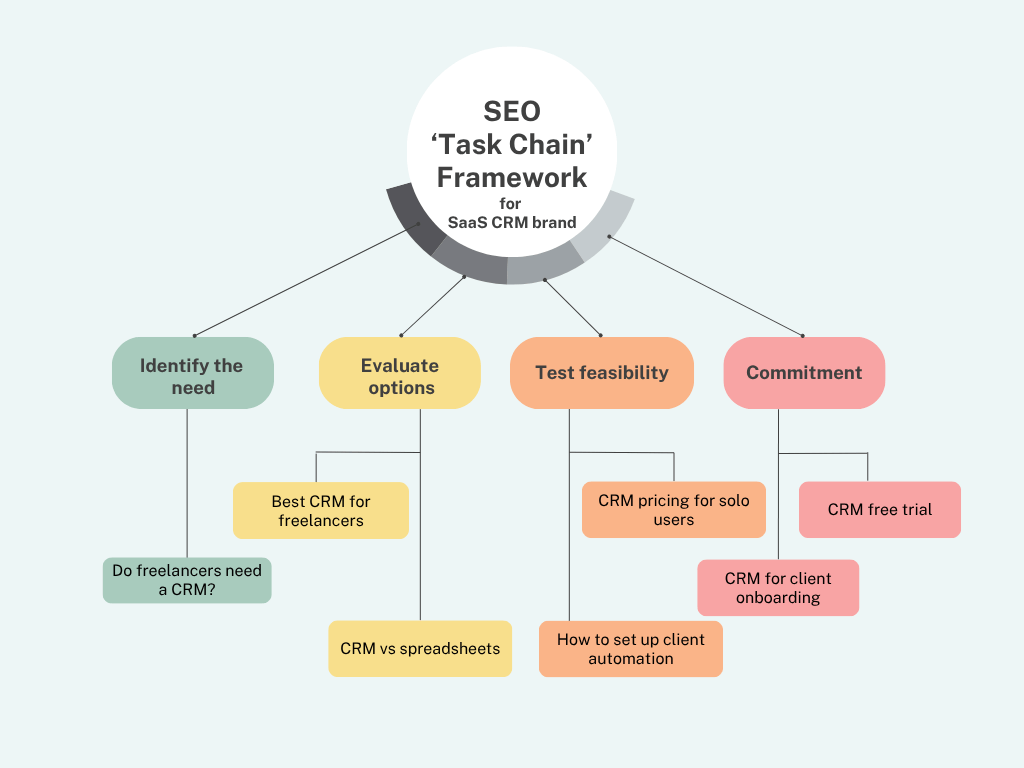
Each query cluster represents a task node and your job is to create content that completes that task in full without sending users elsewhere.
2. Build an Intent Based Content Ecosystem
Doing SEO doesn’t mean making one page at a time. It means to create a content ecosystem that supports your reader’s journey and provide everything they need to know within your own website. Think of it as when your ‘hub’ and ‘spoke’ pages are internally linked and support each other, you’ll ultimately strengthen topical relevance and internal link equity.
SEO Content strategy calendars are ok, but creating topic graphs help you with visual maps that connect your concepts. Here’s how to build it step by step.
- Define the master task: Create a pillar page that must be about a major topic that your users search for (e.g: guide to best running shoes 2026).
- Develop 5-10 supporting pages that further dig into its subtopics (e.g: tread vs treadmill, ‘knee pain shoes’, budget running shoes’, etc) all these supporting pages should link back to the pillar page and also to each other where applicable.)
- Include multimedia like videos, infographics, interactive tools, etc to enrich content and keep users engaged.
- Regularly update all pieces to keep them fresh and trustworthy for your audience.
- Connect them with internal linking. Make sure that each spoke links to the pillar and related spokes where possible. Your anchor should reflect the topic (e.g: running shoes for knee pain
This topic graph mimics how Google’s knowledge graph connects concepts. The tighter and thorough you make your internal graph, the stronger you will be perceived by search engines.
3. Optimize for AI-Driven Search & New Interfaces
We all know that search is no longer confined to Google search bar. Users have so many options to gain more information about their topic of interest via Generative AI, voice assistants, LLMs, and therefore Answer Engine Optimization (AEO) is changing how search engine rankings and visibility is determined. If you’re not focusing on appearing in the AI driven results, you’re losing traffic big time.
Step by Step Optimization for AI-Driven Search
1. Use Structured Data Intelligently
Structured data is your language of communication with AI systems.
Apply these schemas wherever they fit:
- FAQ Schema: Helps AI pull quick Q&A style responses.
- HowTo Schema: Perfect for guides, tutorials, and processes.
- Article Schema: Essential for authority recognition.
- Product, Review, or Recipe Schema: For eCommerce or niche content with measurable properties.
2. Don’t Write for Queries But Conversations
Generative search prefers natural language phrasing. Instead of keyword fragments like best treadmill shoes 2026, use intent-driven conversational phrasing (e.g: ‘What are the best treadmill running shoes for 2026?’, ‘Which running shoes help with knee pain?’, ‘How do I choose shoes for long treadmill sessions?’, etc )
To apply this:
- Use question-based subheadings (H2/H3s).
- Add first-sentence answers directly below them in 1-2 lines just like how you’d reply in a chat.
- Then elaborate with detail below. This mirrors the ‘overview + deep dive’ format AI uses to parse and summarize.
3. Create ‘Answer Blocks’ Inside Every Page
Every pillar or spoken article should include AI-ready snippets that are concise, factual, context-rich summaries that can stand alone.
Format your answer blocks like this:
- Begin with a direct answer in 1–2 sentences.
- Follow with supporting detail, data, or examples.
- Use semantic cue words like in summary, or according to studies, which signal closure and context.
SEO Strategy Example:
Q: How do I choose running shoes for knee pain in 2026?
A: Choose shoes with advanced midsole cushioning, wider toe boxes, and a flexible forefoot. In 2026, models with carbon-infused foam offer better shock absorption for knee stress.
That short, precise block is ideal for AI, while the longform context keeps you authoritative for readers.
4. Optimize for Multiple Interfaces
SEO in 2026 isn’t limited to desktop SERPs. You must optimize for voice search, AI browsers (like Perplexity, Arc, ChatGPT Search, etc), Smart assistants, and also visual queries (Google Lens, Pinterest Lens. The future is cross-interface discoverability, your content should answer no matter where or how it’s accessed.
5. Monitor Metrics That Indicate AI Visibility
Generative search makes SEO different than before. If you notice impressions going up but clicks dropping, that’s not always a bad sign. It often means your content is being used or cited by AI Overviews. Start tracking following to monitor metrics:
- CTR vs impressions: High impressions + low CTR = likely AI surface appearance.
- Brand mentions in AI tools like Perplexity or ChatGPT Search.
- Engagement from indirect channels e.g: copied answer queries, branded searches, or snippets).
6. Format Content for AI ‘Chunking’
Generative engines break pages into semantic chunks. If you make their job easier by structuring content, it enhances your visibility. Use clear, unique H2/H3s with intent-specific language and keep paragraphs short (under 100 words). Try adding lists and tables where relevant, since these are AI favorites.
When the AI model parses your page, it can quote or summarize multiple parts, giving you multi-snippet exposure within a single query.
4. Prioritize User Experience and Technical Foundation
If you’re still confused why your website is not ranking even with high quality content, you may need expert guidance on user experience and technical SEO. As long as your website is slow, unstable, mobile unfriendly, your users bounce and Google signals drop fast. SEO experts reveal that the higher engaging elements your site has the better it performs. Following the below steps, you can improve your user experience and improve your website visibility and SERP rankings.
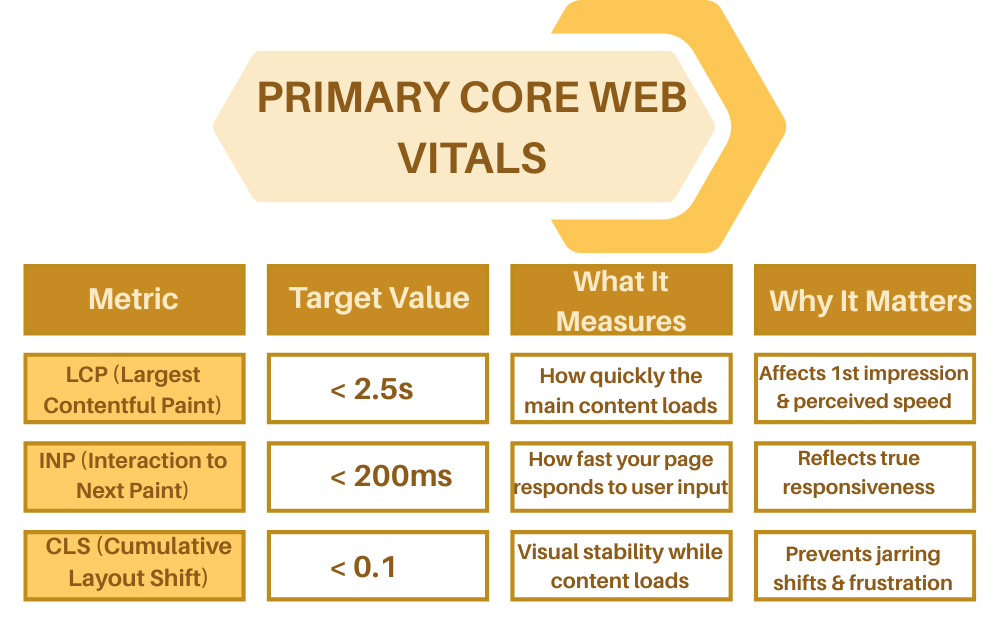
- Audit your site for Core Web Vitals: LCP (Largest Contentful Paint) < 2.5s, INP (Interaction to Next Paint) < 200ms, CLS (Cumulative Layout Shift) < 0.1.
- Optimize images (use WebP/AVIF), defer non-critical JavaScript, use lazy loading, and use a CDN.
- Ensure mobile sites are as good or better than desktop (Google is now mobile-first/only indexing).
- Fix broken links, ensure a clean site structure, and minimize render-blocking resources.
- Use real user monitoring (RUM) data from Google Search Console and analytics to track performance over time.
5. Continuous Authority Building & Trust Signals
Search engine ranking factors 2026 to evaluate your trustworthiness, authority, and credibility are more than keyword stuffing. The concept of E-E-A-T SEO is now a central part for search engines to decide which site deserves to rank.
Experience: Have you actually done what you’re talking about?
Expertise: Is your content backed by qualified or identifiable people?
Authoritativeness: Are you recognized by others (links, mentions, citations)?
Trustworthiness: Is your information verifiable, transparent, and safe?
A study found that websites with good CLS (a UX metric) had on average significantly more linking root domains than those with poor CLS. This shows how performance and authority intertwine.The more real life examples, experience, and professional value you add to your website, the more trust signals it provides to the search engines.
How to do it:
- Make your authors visible: bio, credentials, links to social or industry profiles.
- Use first-party content: case studies, results, experiments you’ve run, and testimonials.
- Earn links naturally: publish original research, tools, resources that others want to reference.
- Monitor brand mentions and search volume for your brand name.
- Maintain link hygiene: avoid spammy links, low-quality guest posts, or link farms.
6. Measure What Matters & Link to Business Outcomes
Ranking for your core keyword e.g ‘best running shoes’ is great, but if that keyword is not helping your traffic enough to appeal them into making a sale, you are not winning. The SEO plan in 2026 means you must tie your keywords into business metrics clearly. You must understand the business value of SEO ranking factors and create your strategy according to it.
When you focus solely on rankings and traffic, you’re celebrating the number of visitors at your store without checking if anyone made a purchase. Your ultimate goal is to enhance your business, therefore start by measuring your conversions, average time on site, repeat visits, and branded search growth. These metrics help you understand how effectively your SEO strategy turns visitors into loyal customers or readers.
We once ran an audit for a client who had thousands of visitors every day but barely any leads. They didn’t track their business outcomes and therefore, we began from there. As soon as we connected their organic traffic data to their revenue through a dashboard, it became clear that most of their traffic came from low-intent keywords making their sales almost negligible.
We restructured their content strategy, targeting high-intent keywords and optimizing pages for conversions. Within months, not only did their revenue rise, but branded searches also increased. Which is a clear sign of growing trust. Regular audits helped us spot zombie pages that ranked well but contributed nothing to conversions. We either removed or refreshed those pages, to improve the site’s overall performance. This experience is a golden strategy if you want to improve your visibility while boosting your business revenue.
7. Hybrid Global and Local Strategy
Many brands are confused how to target both local and global audiences together and therefore resort to one at a time. But in 2026, blending both from the get go is a smart strategy. If you’re operating in a multi-region, you’ll need cultural nuance, language adaptation, and local SEO signals as well as global authority.
The main idea behind this hybrid strategy is to make your brand globally authoritative yet locally relevant.
For global brands, you can earn trust and ranking consistency across regions while adapting messaging, tone, and technical setup for local nuances.
For local business, it’s important to connect with users in the moment through voice search, map packs, near me results, and smart devices that rely on structured local data.
How to Build Global Authority + Local Signals
Global Authority Signals:
- High-quality backlinks from global publications.
- Consistent brand identity (logo, entity schema, social proof).
- Centralized content pillars with localized extensions.
- Strong domain trust and multilingual content structure (hreflang, canonical setup).

Local Relevance Signals:
- Verified Google Business Profiles (GBPs) for each location.
- Locally optimized metadata (‘near me,’ ‘open today,’ ‘in [city]’).
- User-generated reviews and ratings.
- Local citations (directories, associations, press).
- Language and cultural adaptation (not just translation).
8. Governance, Processes & Cross-Functional Alignment
SEO can’t live in silos anymore. You must integrate it across content, development, UX, analytics, and even generate an SEOmarketing plan. It means processes, governance, and clear roles. The difference between successful and unsuccessful websites in 2026 will be how well an organization treats SEO planning as a discipline not a side task that they invest in when budget allows it.
We’ve had many clients that invest thousands of dollars in SEO when their budget allows and stop it completely when they have other financial priorities. But SEO isn’t a one time investment. Once you pause it, your rankings start slipping, competitors overtake you, and all that previous investment begins to fade away. Consistency compounds your results.
Consistently embedding SEO into your daily workflows is critical because:
- SEO now influences everything from UX decisions to brand storytelling.
- Search signals (speed, structure, content depth) are owned by different departments.
- Without alignment, small silos create big leaks of content that doesn’t get indexed, developers that unknowingly break structured data, or analytics teams that track vanity metrics instead of ROI.
A high-performing SEO organization connects every function through shared objectives.
| Team | SEO Role | Core Responsibility |
| Content / Editorial | On-page & topical optimization | Ensure search intent alignment, schema integration, and freshness updates. |
| Development / Engineering | Technical performance | Manage Core Web Vitals, crawlability, site architecture, and structured data. |
| Design / UX | Engagement & accessibility | Optimize for usability, mobile design, and conversion flow. |
| Analytics / Data | Measurement & forecasting | Translate search metrics into business KPIs; manage dashboards. |
| Marketing / PR | Authority & visibility | Build link equity through campaigns, partnerships, and earned media. |
| Leadership | Strategic alignment | Integrate SEO into company OKRs and budget cycles. |
This matrix eliminates blind spots and creates SEO accountability at every layer.
9. Measure Success and ROI
Till 2024, SEOs celebrate when rankings rose or traffic improved, but that’s not the case anymore from 2025 onwards. These are now only surface metrics. The real question today is ‘Did this visibility move your business forward?’ ‘Did your leads, conversion, and revenue increase?’
AL driven search, multi device uses, and zero-click SERPs have shifted how SEO worked. Now even if your pages get good impressions, it’s not a given that your conversions will also increase. Search visibility must connect directly to engagement, trust, and revenue now.
New SEO Measurement Framework
The best way to understand modern SEO is to think in three layers of value:
Visibility Metrics: ‘Are you discoverable?’
Engagement Metrics: ‘Are you relevant?’
Business Metrics: ‘Are you profitable?’
Each layer builds on the next one. Which means that visibility without engagement means you’re irrelevant, and engagement without conversion means your strategy is inefficient.
How to Set Modern SEO Targets
Today, your targets must go beyond ‘+20% traffic’. Set goals hierarchies.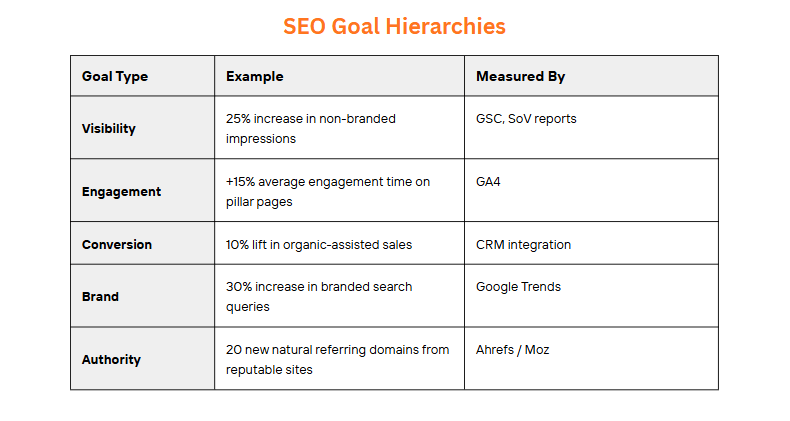
In 2026, you won’t win in SEO with isolated tactics. Search Engine Optimization is much more complex than it used to be, and only when you use a layered SEO strategy will your website generate the ROI you’re looking for.