

Guide to Answer Engine Optimization
Search is in the throes of the most significant transition since Google’s rise to popularity. And we’re now moving into an era of AI SEO and AEO (Answer Engine Optimization) in which the goal is not to simply appear on search engine results pages, but be a destination that AIs really trust, cite, and recommend. Google AI Overviews, Bing Copilot, Perplexity & ChatGPT are becoming vital platforms where brands need to consider while optimizing their websites.
In this guide, we’ll be learning how to optimize your website for AI search and new answer interfaces. Let’s Get Started!
What is AI Search Engine Optimization and Why It Matters
Artificial intelligence search engine optimization means to ensure your content can be ‘read’ (interpreted), as well as trusted, used, and reused in AI-driven search engines. These AI-driven search systems include large language models (LLMs), answer engines, and generative search interfaces that often sit between users and traditional blue link results. AEO helps your content to appear in a handful of sources that AI refers to when creating answers.
Unlike traditional SEO, AEO emphasizes:
Being Selected as a Citation Source in AI Summaries
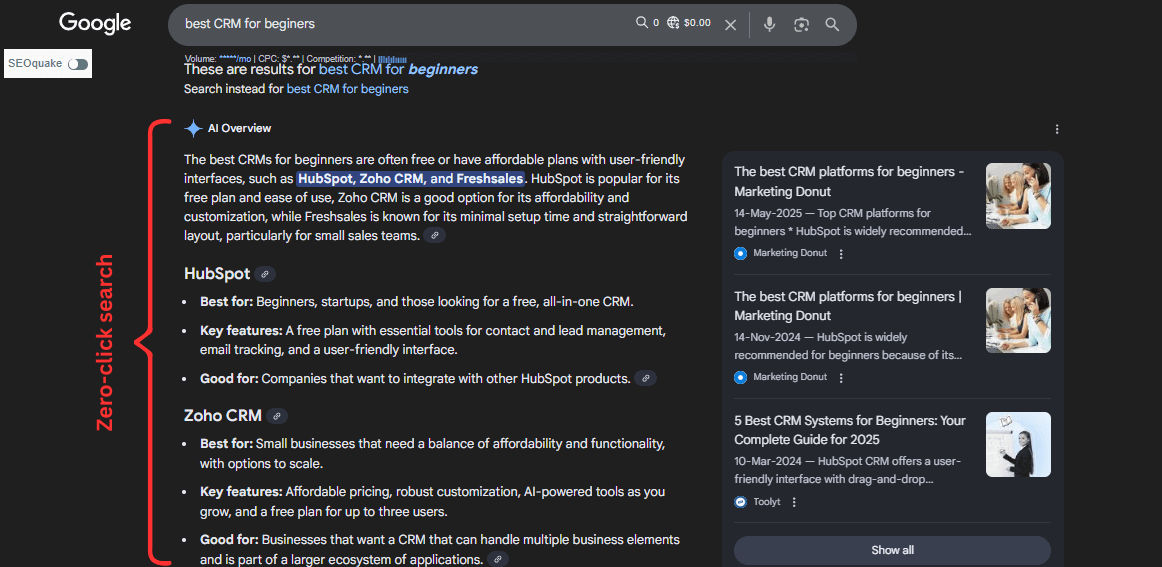
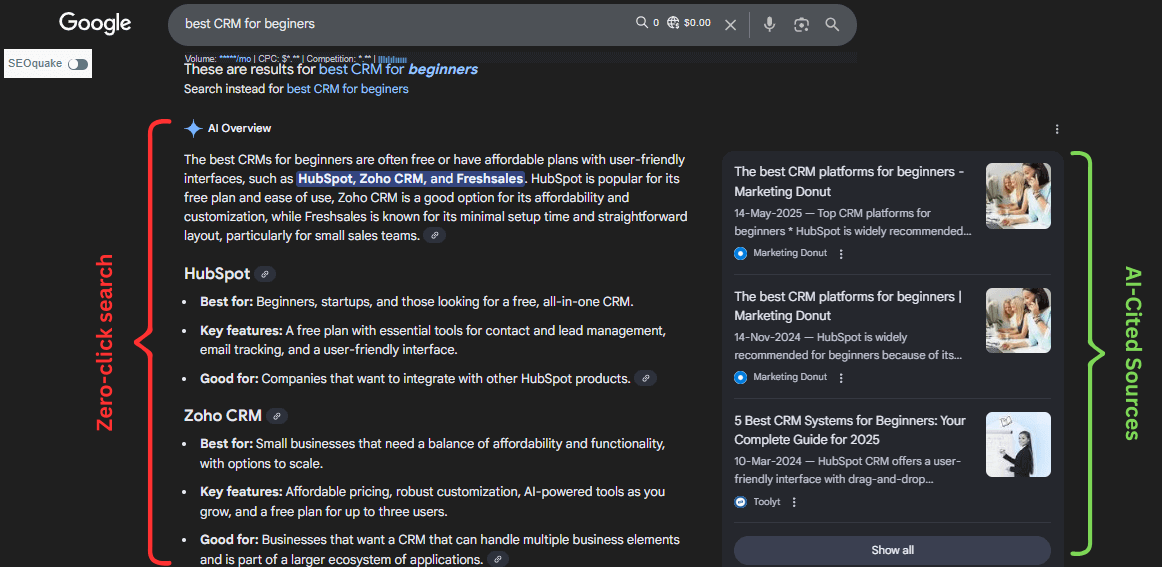
AI tools usually reference one to three trusted pages when creating summaries. If yours is chosen, you gain visibility even in zero-click environments.
Making Content Answer-Friendly and Semantically Structured
Clear subheadings, explanations, and logical structure of content help AI understand your content more accurately and increase the likelihood that you’ll be tapped as a source.
Providing Fact-Driven, Expert-Led Insights
AI loves the content that speaks with expertise and is verifiable. When you provide good, insightful information, it makes your pages more reusable in the output of generated responses.
Reinforcing Brand EEAT SEO Signals
All the above factors lead to the demonstration of experience, expertise, authority, and trust in your credibility in the eyes of AI systems and search engines.
As AI-generated responses become the norm, only those who lean into it will remain present, while others get lost in zero-click canned responses. To create a strategy that drives these outcomes, all businesses should begin with a contemporary search engine optimisation that leads the way to answer engine optimisation.
The Shift Towards AEO and Zero Click Search
In traditional search, you enter a query and see blue links, clicking on which leads you to visit a website. But AI-powered search makes that journey a lot shorter. When a reader adds a query, it only takes AI systems to feed them with a generated, conversational response compiled from several validated sources. In a lot of cases, they don’t even have to click on any one result. This is called zero-click search, and it’s rapidly becoming the standard operation of generative AI tools that prioritize convenience and speed. It may sound like a loss for websites, but it is actually an opportunity of another kind.
How Does it Benefit Your Business?
When your content is used as one of the sources supporting an AI-generated answer:
- Your brand gets immediate recall, as the answer references your name directly.
- You influence decisions without so much as needing a click, especially when you’re offering valuable, clear, and authoritative information about your target topic.
- You get authority citations that further boost your trust signals on both AI systems and classic search engines.
- You still attract the most motivated users who are willing to click through for more in-depth information.
AI search increasingly supports the brands that show strong topical authority, deep domain expertise, and consistent entity signals across their content ecosystem. The more clearly your site demonstrates these strengths, the more likely AI systems are to recognise it as a reliable source worth citing.
How does AI Read and Rank Your Content?
AI-powered search engines don’t evaluate content the same way traditional keyword-based systems do. Instead of simply matching phrases on a page, large language models analyze the deeper meaning of your content and how well it fits into a broader knowledge network. To do this, they focus on three core elements:
Entities
To begin with, AI identifies key things mentioned in your content, such as people, companies, product categories, locations, medical conditions, and industry terms. These entities help the system understand what your page is about and where it fits within a topic ecosystem.
Relationships
Once entities are determined, the AI system now examines how they connect with each other. It looks for patterns such as cause and effect, hierarchy, similarity, and relevance. The stronger and clearer you build those relationships, the easier it is for AI to classify your content as authoritative on a topic.
Semantic Meaning
Rather than relying on exact-match keywords, AI interprets the intent, context, and depth of your writing. It asks:
Is this information accurate?
Does it fully answer the question?
Is it aligned with how experts discuss this topic?
This is why semantic SEO is so important today. It focuses on structured topics, strategic internal links, entity-focused writing, and clear context signals. Semantic SEO increases your chances of being selected as a trusted source in AI-generated answers by helping them understand your content more accurately. Although it’s easier said than done, with a little help from SEO experts and a guide on how to build a content ecosystem, you can make your content stand out both for search engines and answer engines.
Content Structure That Wins With LLM-Powered Search
AI answer engines don’t just read your content like a reader; they scan it for structure, clarity, and extractable value. To become a trusted source, you must use strategic SEO content writing and format the pages in a way that makes it easy for LLMs to identify answers, interpret context, and pull information directly into AI-generated summaries. Content that performs well in this environment typically includes the following characteristics:
Answer-First Formating
AI likes pages that offer a clear, definitive answer right at the top. When your article begins with a simple explanation or definition, LLMs can easily classify your page and confidently reuse it in their responses.
Clear, Logical Headings
A powerful H2/H3 hierarchy assists AI in segmenting your content into digestible chunks. Each heading serves as a signal that defines a subtopic, helping LLMs figure out how your article fits into the landscape of user intent and topical clusters.
Highly Extractable Sections
AI models are always looking for information that can be directly pulled into summaries. Elements such as tables, bulleted lists, short lists, and key facts snippets enable Large Language Models to pull out facts without misunderstanding your content. This makes it more likely that your content will be cited.
Fact-Driven and Expert-Supported Writing
LLM only trusts the content that shows expertise and accuracy. Citations of reliable information, studies, and facts established through practical application strengthen your authority signals faster than any backlinks. The more credible your content looks, the greater the chances are that AI will use it in generated answers.
On-Page Optimization Checklist for AI Search Engine Optimization
If you want to rank in AI-driven searches, your content must be generated and formatted in a way that LLMs understand, trust, and reuse. Let’s go through some of the essential on-page elements and why each one plays a critical role in AEO performance.

Answer Paragraph
Start your article with a brief, authoritative answer to help AI systems pull key information out quickly. It makes you more likely to get pulled into summaries in which only a couple of sources are cited.
Entity-Rich Introductions
Mentioning key organizations in the intro, like brands, industries, tools, or concepts. This improves the semantic indexation and helps AI models know the scope of your topic and where your page fits in larger knowledge graphs.
FAQ Blocks with Schema Markup
FAQ sections are hacks for AI engines. They don’t need to look anywhere else if your FAQ section answers everything they’re searching for. When you combine these goldmines with structured data, they immediately improve your discoverability in generative search tools and improve the chances of being reused in AI summaries.
Internal Linking
When you strategically interlink your own content to other related content, your topical authority strengthens. The more your pages are interconnected, the easier it will be for AI to believe that you are an expert on a topic as a whole.
Author Credibility
Providing actual author bios, credentials, and experience adds equity to EEAT, YMYL signals. AI models surface content authored or reviewed by those with clear expertise in the field.
Structured and Scannable Design
AI works better with content that’s formatted neatly. Making your paragraphs bite-sized, adding self-explanatory sub-headings, lists, bullet-points, and graphics makes LLMs understand your content without getting overwhelmed.
Updated Stats and Sources
Fresh data strengthens your trust signals. AI systems prefer current, validated content with a reliable source. When you keep your content up-to-date AI search engines find you more reliable and trustworthy.
Building Topical Authority with Content Clusters
One of the most powerful signals that AI search engines use to determine trust is topical authority. Rather than assessing an individual page in isolation, LLMs consider how comprehensively and to what extent you cover a topic across your site. This is where topic clusters come into play.
A topic cluster is a collection of interlinked articles centred around one pillar page. These interlinked pages tell search engines that your brand understands the topic from all sides.
For AI SEO, a cluster might be something like this:
Pillar Content
This is your number one complete guide on your topic. It establishes important concepts, frameworks, and strategies that the rest of your content piece goes on to support.
Supportive topics for Cluster Pages
These are deeper-than-average platform information, dealing with subtopics that readers and AI no longer suspect to be present in the AEO world.
Zero-Click Search Strategies
These strategies describe the ways in which brands can be found when users no longer click on historical traditional search results.
AEO vs SEO differences
This reveals the transition from old-school keyword-based search engine optimization to entity-informed AI-driven search optimization.
Entity-first writing methods
Demonstrates how to format content so AI models can more readily identify entities, relationships, and context.
AI content optimization tools
Offers a rundown of the software and technologies to enable automation of semantic analysis, content restructuring, and implement improvements in EEAT.
Contextual link building
Emphasises the potential for contextual link building to increase authority and enhance semantic relationships.
Authority Signals for AI Ranking
AI search engines rely greatly on the authority signals for making decisions about which sources should be referenced in their answers. An important part of the LLMs’ lifecycle is further establishing whether the content can be considered trustworthy and safe to reuse. By tracking new guidelines and focusing on these authority signals through the latest SEO guide 2026, you can improve the chances of your pages being featured in AI summaries and answer boxes.
Expert Authors With Credentials
Content authored or endorsed by professionals is rated highly both in search engines and answer engines. If you add clean author bios, credentials, and real-world experience in your content, it enables AI systems to confirm your legitimacy and interpret your content as credible.
First-Party Research and Insights
Original information, proprietary analysis, and the firsthand angle are all very powerful ways to distinguish yourself from others. AI is biased toward the brands that offer something valuable that doesn’t already exist on the web.
Citing Reputable Studies
Adding references from authoritative publications, scientific journals, and well-known sources is essential to maintain the true facts. This enhances both human assurance and machine-readable credibility.
Transparent Editorial Review
Pages that exhibit some degree of editorial oversight, such as reviews, updates, or expert verification of content, seem more reliable to readers as well as AI crawlers. AI reads these cues in order to judge how thoroughly you have vetted the information before publication.
Brand Consistency Across the Web
A good digital footprint helps LLMs to identify whether you are who you say you are. With consistent branding, entity signals, and messaging on your site, social channels, and when you are being spoken about outside of your domains, improve your recognition in the AI’s.
Conversion Strategy for Zero-Click Search
Zero-click searches are golden opportunities for brands. Even if a user doesn’t come to your site directly, with zero-click searches, you can still impact how they think about your brand and influence their future behaviors. When you optimize for strategic visibility in the AI-generated answers, you are creating familiarity and trust with the audience that can lead to conversions further down the road. It’s a great lead generation strategy in the long term.
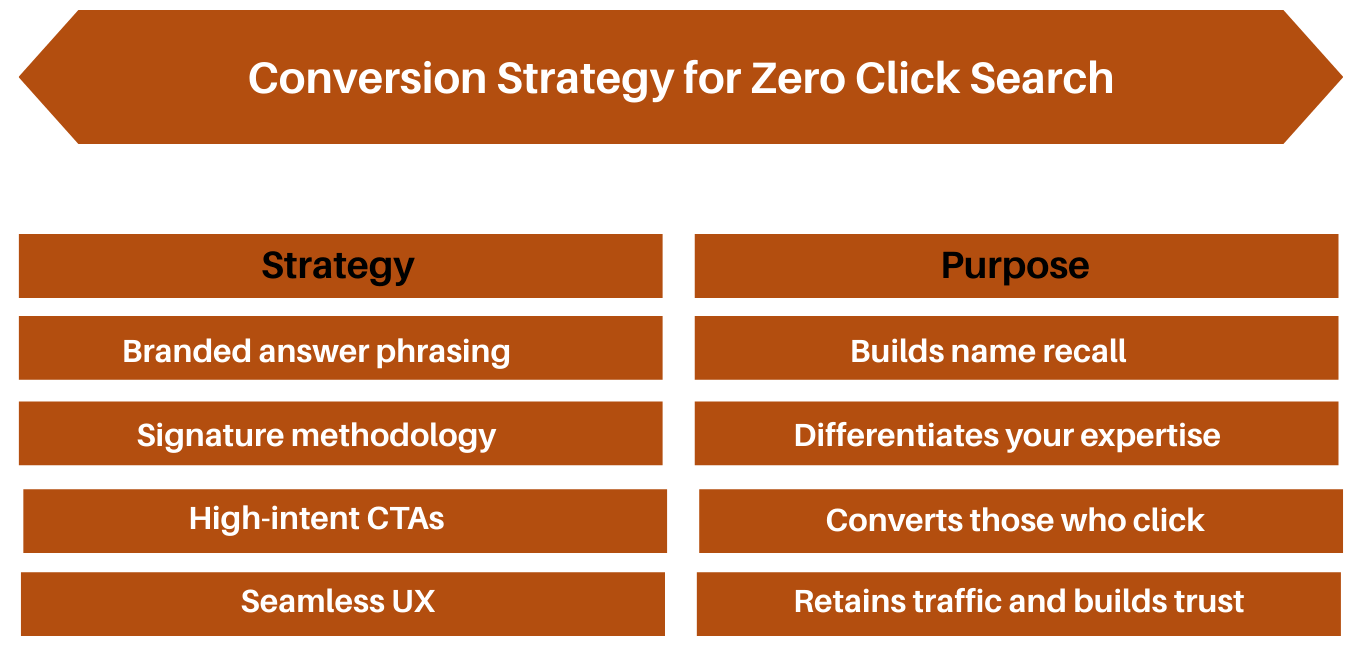
Branded Answer Phrasing
When AI refers to your content and your name consistently pops in searches, people increasingly trust your brand with valuable explanations and professional tips.
Signature Methodology
If you describe your proprietary frameworks or methodologies in content, it sets your expertise apart from others. These tactics reinforce your position and increase the likelihood that users look specifically for you later.
High-Intent CTAs
Although zero-click search diminishes traffic to your website, the motivated users click through for more detailed advice. If your content is filled with clear and compelling calls-to-action, those visitors can easily be converted.
Seamless User Experience
Visitors should land on your site and experience a quick load time, an appealing design, and ease of navigation. A seamless UX also creates trust and forces people to explore more and turn those passive readers into active leads.
All these strategies will keep your brand front and center, memorable, and easy to convert with, even as clicks get snug. If your brand is losing out on traffic and would like to improve your AI search results, contact our SEO experts for a free consultation and AI SEO strategy planning.
3 Month Strategy to Implement AI Search Engine Optimization
You may have all the information on AEO in the world, but implementing it correctly is the key. We’ve created a 90-day plan for you to follow for a successful AI Search engine optimization for your website. You can also reach out for a free consultation plan from SEO experts. Let’s take you through each phase one by one.
Month 1: Technical foundations and entities
Your first month establishes teh foundation of how AI systems will understand your website. Therefore, you must make it as impactful as possible.
AI-based content audit and entity mapping
Assess your current content for any gaps, absent entities and concepts, weak semantic signals, and pages that need an update. Mapping your main entities can be a good guide for your clustering of topics in the future.
Canonical cleanup
Start by content strategy plan to clean up the duplicate content and merge thin pages. Make sure that correct canonical URLs are in place since cleaner signals make it easy for AI crawlers to understand your content and develop trust.
Schema deployment (FAQ, Article, Author)
When your data is structured and easy to read, it helps AIs extract answers more accurately. Pay attention to the article schema as it helps with clarity, the FAQ schema boosts your content inclusion in summary, and the Author Schema sends EEAT signals to the AI search engines.
Build a strategy for the content ecosystem linking.
Sketch out the interlinking between pillar pages, clusters, and supporting content. When your pages are tightly interlinked, it supports semantic relationships and enhances crawlability.
Month 2: Content Expansion
Now that you have your technical base, your second month should be focused on growth.
Publish new content clusters centered on target entities.
Many brands make the mistake of stuffing their website with generic guides for any and every topic. If you want to build your authority in a specific industry, create pillar pages and then publish their supporting articles that let AI know your level of mastery. Every cluster you build reinforces your site’s place in a topical ecosystem.
Update older posts with the latest stats.
Data is changing every single day, and therefore, refreshing older content signals relevance to the latest information. When your pages have updated data, contemporary examples, and enhanced structure, they are naturally ranked higher by AI engines.
Add internal links to reinforce topical relationships.
On-page optimization is just as important as off-page optimization. Adding links between cluster pages, pillar pages, and related resources helps you position yourself as a credible source of information. This content strategy not only increases your site’s topical authority but also overall semantic density.
Month 3: Authority & Optimization
Now that the basic framework and initial growth are laid out, the 3rd month is all about building trust signals and getting your site ready for long-term AEO success.
Add first-party data and expert analysis.
When you add your original research or experience, proprietary data, and expert opinions, it radically increases your authority in the eyes of AI, which always favors content that provides new information.
Publish thought leadership content.
In this tight, competitive digital market, good written content can only take you so far. Now you must release special insights, industry commentary, or expert opinion that broadens brand perception and increases EEAT sitewide.
Begin AI answer performance tracking.
Track how often you are cited by the AI-generated summaries and make changes to your content based on the performance metrics.
The Bottom Line
Future success belongs to those brands that know how to balance both SEO and AEO now. If you invest in your AI search engine optimization, AEO, and answer first content, Semantic SEO, and content cluster, authority signals, and expert-driven insights, as well as a scalable content ecosystem, no one can stop you from becoming an industry voice.