
How To Build a Content Ecosystem?
Most brands treat content like a check box. They create individual blog posts, publish them, move on, and rinse and repeat. There is no connection between the content pieces, and the website looks like a scattered spreadsheet, which leads to random traffic, inconsistent rankings, and almost no conversions.
In 2026, SEO and marketing don’t succeed by isolated content. They perform great when your content is connected and the whole website is easy to navigate, both for the readers and search engine crawlers. Creating pages that work together to educate your audience and convert them across multiple stages of their search journey is the ultimate hack to successful SEO content now.
This is exactly why the content ecosystem can be your biggest advantage. It’s not a simple SEO strategy; it’s a complete framework of growth that indicates to search engines that you know what you are doing. A content ecosystem helps you strengthen your marketing, improve lead generation, and also make your brands more visible across traditional SERPs as well as AI driven results like SGE, ChatGPT Browse, Perplexity, etc.
What is a Content Ecosystem?
A content ecosystem is a structured network of pages, guides, videos, infographics, and tools that support each other across your website. Think of your website as a city. There are many highways, smaller streets, and places people visit for specific needs. Everything is connected, and every street leads to the other one in a structured way.
Similarly, you need to create an extensive roadmap for your website by connecting the pages together through links. A content ecosystem guarantees that no piece of content exists in a vacuum and contributes to your brand’s boost. A visitor lands on one page, but the ecosystem leads them naturally to where they need to go next, whether that be more information, considering possibilities, or becoming a lead.
A strong content ecosystem helps you provide a smoother and more complete user journey while building topical authority to boost rankings. When you align your content with marketing, sales, and lead generation goals, content ecosystems promise more conversions as compared to thoughtless content streams. It also ensures that the AI platforms can understand and reference your brand, especially when supported by the latest SEO strategies 2026
Components of Content Ecosystem
A content ecosystem consists of a number of different parts that all work in harmony with each other and contribute to one mission.
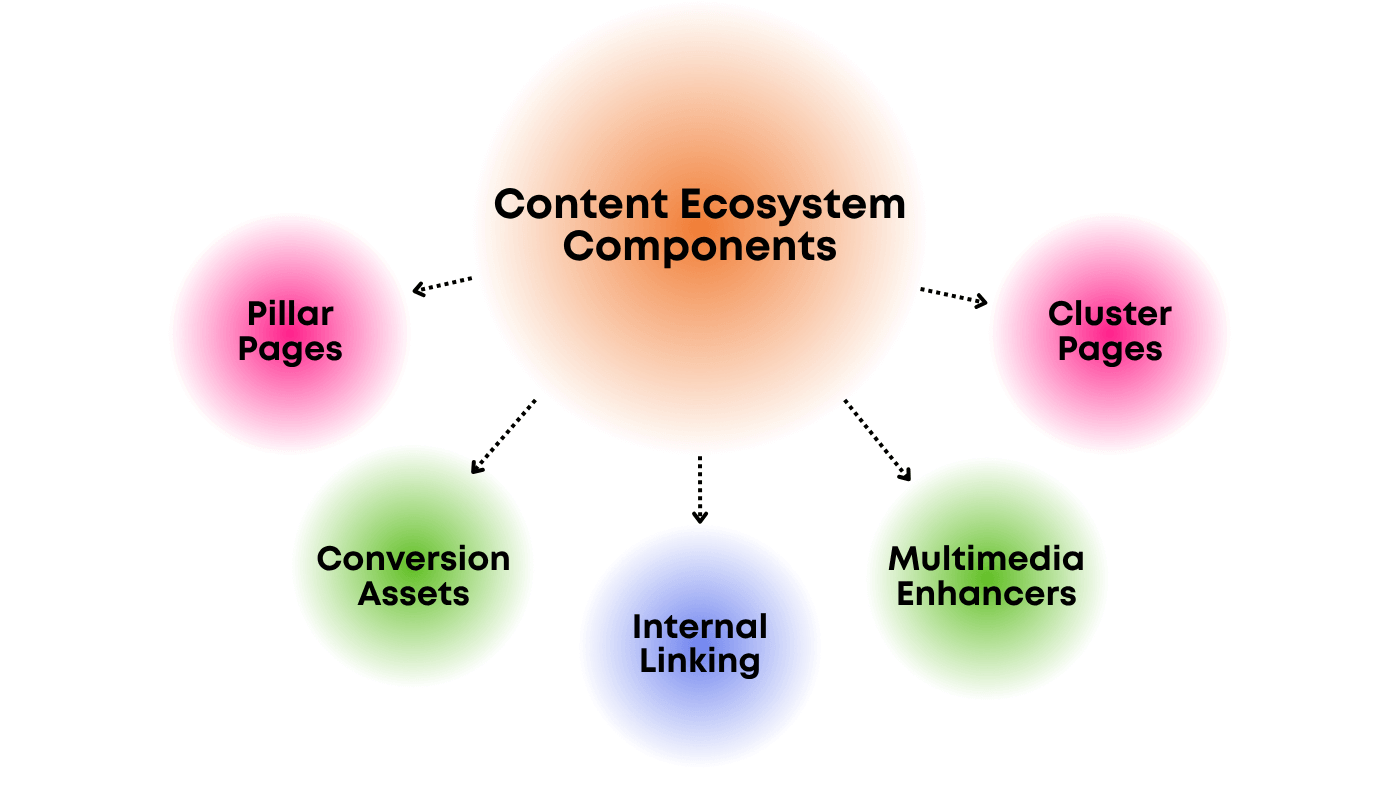
Main components of healthy content systems include:
Pillar Pages
Pillar pages act like the anchor of each broad topic. They are your big, high value guides that cover your topic in a broader way and act as the primary entry point. For example: ‘Complete Guide to Email Automation 2026’. This pillar sets the topic and introduces subtopics in its body.
You begin with a pillar page and make a framework of all the subtopics that you will be talking about in its body.
Cluster Pages
Once you have your pillar page and a framework of what its subtopics are going to be, you’ll then create a deep dive into each subtopic. These pages answer very specific questions or solve granular problems like ‘how to make welcome email workflows’ or ‘email automation for small businesses’. These clusters are derived from the pillar pages, but provide in-depth information and value to your readers. These cluster pages help your readers to gain more value while staying on your website for longer durations, thus enhancing engagement.
Conversion Assets
These are tools that lead your traffic from education to action. This may include checklists, templates, email scripts, mini-tools, or even PDF guides, anything that brings about an action from your traffic. As the name suggests, conversion assets help in improving the conversion rate by turning your organic visitors into leads.
Internal Linking Pathways
This part of the content ecosystem acts as the circulatory system. The internal links lead users to the next helpful resource and also provide Google with clear information about which resources make sense together.
Multimedia Enhancers
Multimedia elements change the way people interact with your content. While text builds understanding, the visual images, graphics, and videos make it stick. By including things like photos, infographics, short explainer videos, charts, or even basic interactive tools, your audience gets another way to consume and remember what you’re conveying.
When people stick around your website and interact with multiple formats while scrolling, the Google ranking system receives stronger behavioral signals. This way, multimedia elements reinforce both your SEO performance and users’ trust.
Benefits of Content Ecosystem
A single blog can certainly get you traffic, but it can’t build authority, trust, or conversions. Content systems help your audience to engage for a longer duration on your website and give them time to build trust and guide them through every stage, leading to conversions.
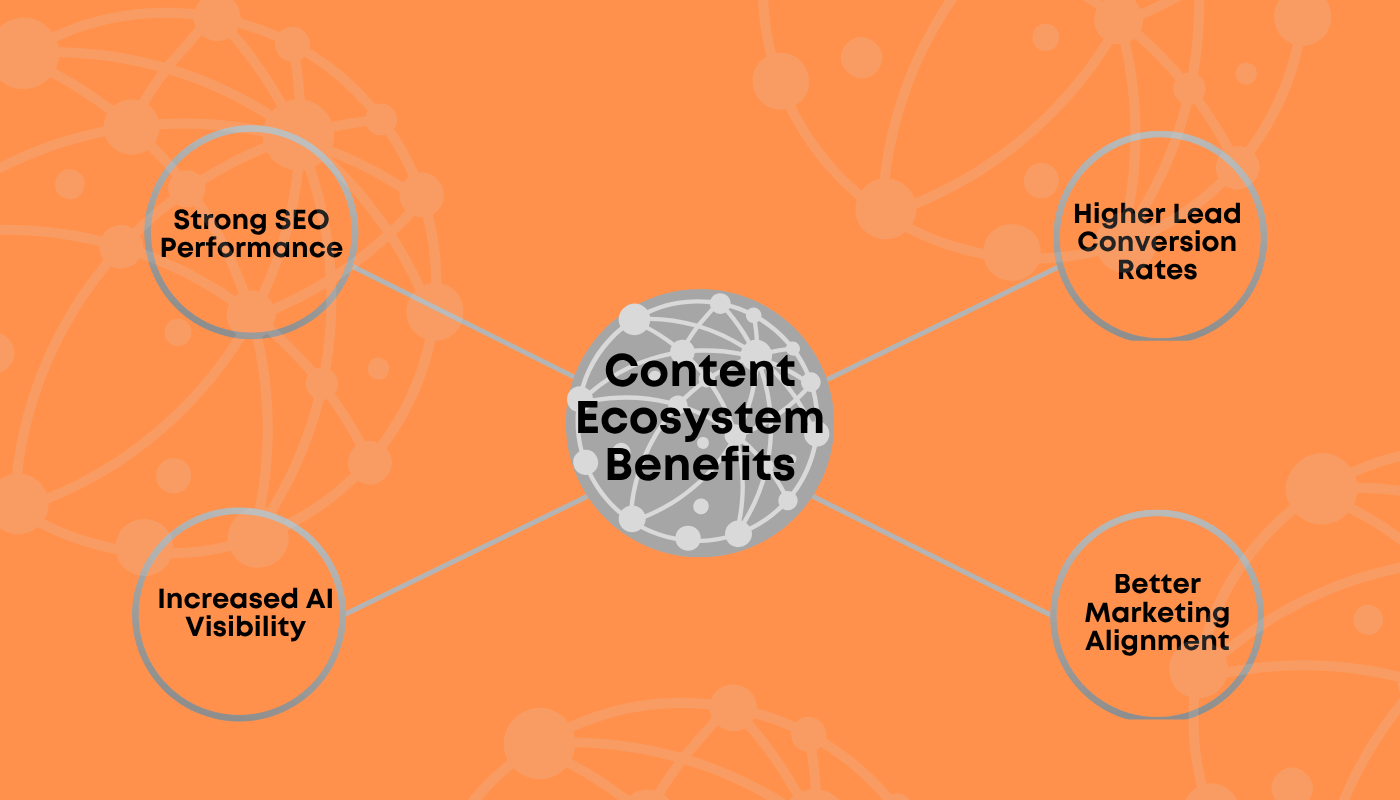
For this system to work, every asset needs to be written with clarity, structure, and intent, which you can strengthen through professional support like reliable content writing services. Here’s why it works so well across both SEO and marketing perspectives:
Strong SEO Performance
Google loves topical depth, internal coherence, and semantic clarity in content pieces, and a content ecosystem does all three things well. By approaching a topic from various directions while pairing it up with comprehensive search engine optimisation strategies, you make it more likely that Google will understand you to be an authority on the subject, and this helps with rankings for both competitive short-tail keywords (like ‘email automation’) and long-tail keywords like (‘how to set up automated email sequences’).
Better Marketing Alignment
Nobody’s just throwing content on their website for free. Everything ties back to specific marketing goals. The pages at the top of the funnel raise awareness of your brand, while mid-funnel resources help to evaluate options for making a decision, and bottom-funnel resources are designed to drive action.
Higher Lead Conversion Rates
The more natural path you give your readers to follow, the more likely they’ll be to download your templates, try your tools, or sign up for your offers. A content ecosystem working in a sequence of ‘Cluster → Pillar → Lead magnet’ becomes a lead generation system and enhances your conversions by several folds. Find out more about how to generate leads for better ROI.
Increased AI Visibility
AI visibility today might be more important than SEO itself. The AI models are helping your audience find their desired results without them having to click on the Search Engine Result Pages. Therefore, it’s more important than ever to make AI models reference your content for your industry. What AI models are looking for are content depth and relationships. The connected ecosystems increase your chances of being included in the SGE summaries, AI conversational answers, and tool-provided recommendations.
Steps By Step Guide to Build a Strong Content Ecosystem
Start With a Pillar Page
Your content ecosystem starts with a single, high-value pillar page that owns the foundation topic your audience is most interested in. But we’re not choosing this topic because it has good search volume; we’re picking it because it’s a real user goal. To select a topic for a pillar page, you must know what result your audience wants. What problem are they solving from beginning to end?
For example… Instead of publishing a run-of-the-mill blog post like ‘What Is Email Automation?’, create something absolutely comprehensive, like an ‘Ultimate Guide to Email Marketing Automation 2026’ or ‘Email Automation Strategy for Beginners.’ That class of pillars articulates an entire journey, teases out subtopics, and levies order on readers who are confused by hundreds of publications out there.
A good pillar page should be the home base for someone researching a particular topic. It should address basic questions, define terms, provide models, and lead readers naturally to related material by means of internal links. This page ultimately becomes your semantic anchor, and the highest-trafficked and most-linked-to page on your website.
Use Cluster Pages to Answer High-Intent Needs
After you establish a pillar, you can then move on to creating the cluster pages. As we discussed, these pages are the in-depth, precise pieces that address the questions people ask as they search their way through solving larger problems. These articles can target those long-tail keywords like ‘how to write a high converting automated email’, ‘best email marketing automation software for your online store’, etc.
These cluster pages are where the true SEO power of your ecosystem resides. They show both readers and search engines how deeply experienced and well rehearsed you are.
Add Conversion Assets Inside the Ecosystem
Your content ecosystem becomes a business engine when you add conversion assets. These assets are actually the details that assist readers in doing something that leads to conversions. Blog posts alone hardly ever convert, but content that is underpinned by templates, tools, and guides wins over readers into subscribers or customers.
Examples of conversion assets could be things like downloadable email templates, checklists on how to set up automation, workflow map diagrams, step-by-step PDFs, a calculator, or a quick tool that gets the user to their desired task faster. These are not salesy but rather helpful shortcuts. They make an on the spot offer in return for the reader’s contact details and so they are very easy to say yes to.
The best place to do that is everywhere users show intent. When a person reads ‘how to build an onboarding email flow,’ that’s the precise time to offer them a free onboarding workflow template.
Build Intent-Based Internal Linking
Internal linking is the step that connects all your pages together in a framework. We’ve seen many brands doing internal linking mindlessly by throwing 2-3 links here or there. But internal links are a user guidance system. Each link should be a logical next step that helps your readers navigate deeper into your content without any issues.
To do it well, you need to think like your readers. If someone is reading ‘best email automation tools for small business,’ the next question your readers might search for is ‘Okay, now how do I set it up?’. That’s your cue to guide them to a cluster page that explains how to set up email automation workflows. This flow mirrors your reader’s curiosity and is exactly what search engines are expecting to see.
Good internal linking also helps distribute authority among your pages. In short, the pillar page you create will gain strength from clusters, while clusters will gain depth from each other. This is how user engagement signals travel throughout your content ecosystem.
Include Multiple Content Formats
Since thousands of content pieces are already present across the web, search engines now love uniqueness and multimodal content that helps users learn in more than one way. Most users don’t have the time or patience to grow through the complete content in one go. Some skim, some watch, some absorb your content through visuals, while some want hands-on tools. When your content ecosystem includes a large variety of formats, it automatically becomes trustworthy in the eyes of search engines as well as users.
The multiple content formats can be anything from short explainer videos to step-by-step visuals, infographics, interactive tools, comparison charts, or even real case studies. These formats are not for good looks only; they, in fact, improve engagement, dwell time, conversion, and retention.
Keep Your Ecosystem Updated Regularly
Just like plain blogs, your content ecosystem also needs an upgrade every quarter. Search behavior of your audience changes every other month, tools upgrade, new competitors emerge, and AI systems constantly update their criteria according to user needs. That’s why regular content updates are vital for staying visible and trusted.
Review your content at least every quarter and make adjustments to replace outdated screenshots, infographics, old examples, expired tool references, broken internal links, or more. Repeating it constantly keeps your authority strong and also signals freshness to search engines and AI platforms which love to prioritize updated and high quality sources.
How To Turn Your Content Ecosystem Into a Growth Engine
A holistic content ecosystem doesn’t just make your website better, it also creates compounding, sustained growth across SEO, marketing, and sales channels. Rather than just depending on individual blogs to take off, every single page supports the next to improve engagement and reap the best results in the long term.
From an SEO standpoint, this structure allows you to rank with both short-tail and long-tail keyword strategies because Google can now see your depth and authority on the subject. It is precisely this topical authority that search engines and AI platforms value when deciding which brands to include in summaries, snippets, and conversational answers.
For marketing and lead generation, your ecosystem acts as a guided tour. Even if a user landed on your page without any thoughts to perform an action, your content ecosystem takes them through an appropriate flow from awareness to consideration to action. Every internal link and supportive resource is educating them in less time to make more qualified, conversion-ready leads.
It also improves user experience so that your readers stay longer, go deeper, and come back more often because they see your website as an authoritative, well-managed resource for answers.
This system helps you draw traffic, nurture leads, and establish authority even when you’re not publishing regularly.
The Bottom Line
The volume of blogs alone doesn’t help your website to become an authority in your niche. Although volume does play a role, the structure, purpose, and connection of content are what make your website successful. If your rankings, conversions, or ROI are still stuck at the bottleneck, your content ecosystem may need an upgrade. Take advantage of our content strategy services to boost your content plan for better ROI.