
Keyword Research Is Dead: Find Out Why Intent-Driven SEO Is the Future
There was a time when keyword research was all about numbers that included search volume, CPC, KDP, and density. Marketers stuffed the pages with high-ranking keywords, hoping that Google would notice them, and it somewhat worked if you were lucky. But today, AI-driven search, semantic understanding, and user intent are the main concepts that lead Search Engine Optimization. SEO hacks and tricks don’t work anymore. Just like all of us, you are dropping your queries on ChatGPT Browse, Perplexity, and Google’s Search Generative Experience (SGE), which give instant answers and think more like humans. That’s exactly why SEO has become even more complex. Search engines and AI driven searches don’t reward repetition, they love relevance and understanding. If you want to be successful in SEO, you must focus on what users are trying to find, not just what they type. This shift from keyword stuffing to intent driven SEO has changed everything and you can only gain an edge if you catch up with latest upgrades sooner than your competitors.What is Concept and User Intent?
Every query that we drop into search engines or other Generative AI platforms has an intent behind it, right? Understanding that intent and giving solutions according to it works much better than any keyword stuffing strategy. If you’re still targeting isolated keywords like ‘best running shoes’, it’ll no longer work. The modern searchers think and expect differently. They ask: How to choose running shoes for treadmill vs trail? Or, what are the best running shoes for knee pain in 2026? Etc. These are not simple queries, but rather questions that need genuine answers. The users are already overwhelmed by hundreds of choices, and are hungry for helpful, humane answers, not clickbait. That’s your user’s first pain point: ‘content fatigue’. People are tired of generic advice that fills each page they click. So, think about how you can solve it for them in a way that sets you apart. The answer is ‘shifting from keywords to concepts’. Start thinking like a problem solver, not a mere publisher. If your focus keyword is running shoes, create a complete topic cluster around it. It can include articles covering all subtopics that fall under the category of running shoes, like: trail vs treadmill shoes, shoes for knee pain, or the best affordable running shoes in 2026. This structure shows Google you understand the entire topic ecosystem. As Ahrefs advises, ‘create high-quality, search-focused content around topics with business, search traffic, and ranking potential.’ By connecting related topics and answering layered questions, you’ll attract readers at every stage, from curiosity to purchase.Importance of Long Tail Keywords
Marketers love to use short-tail keywords because, yes, those search volumes look impressive. But there’s a harsh truth that no one likes to admit: ‘Big numbers don’t always mean big results.’ Someone typing ‘CRM’ is probably just browsing. But when they search for ‘best CRM for freelancers 2026’, that’s a completely different story. That’s the intent. That’s someone looking forward to making a decision. And yet, so many businesses still fall into the trap of targeting high-volume keywords that bring in clicks but not customers. They end up celebrating vanity metrics like: ‘Look, we’re ranking!’ but ignore the fact that no one’s converting. Long-tail keywords are the tools actually packed with real intent. They might get fewer searches, but they attract people who really want what you’re offering. Look for phrases that include natural modifiers like “how to,” “for beginners,” “vs,” “2026 edition,” or “step-by-step.” These tiny words reveal micro-intent, i.e., clues about where the user is in their journey and what kind of help they’re looking for. You can use tools like Ahrefs, Semrush, or AnswerThePublic to find the best performing long-tail keywords for your respective industry. But don’t stop there. Step into your reader’s shoes. Ask yourself:- What’s frustrating them right now?
- What’s confusing about their choices?
- What would actually make their life easier?
How Search Intent Shapes the User Journey
When you really think about it, every search starts with a question, but it’s not always the one you see on the screen. Behind every typed phrase is a tiny story. Maybe someone’s confused, curious, or simply trying to make a choice. For example, if there is a simple query about the best CRM for freelancers. People are not expecting to find definitions of CRMs; they want to solve their problems. That’s where search intent comes in; it shows you why people search, not just what they search. And that’s exactly where great SEO content wins. Instead of treating your content like a traffic magnet, treat it like a tour guide. Your reader is already on a journey, and your job is to meet them exactly where they are and help them move forward. Here’s how that can look:- If they’re just learning, use explainer posts like ‘What is CRM software and how does it help freelancers?’
- If they’re comparing, write evaluation content like ‘CRM vs spreadsheet: Which saves more time?’
- If they’re ready to buy, lead them to conversion content like ‘Set up your CRM in 10 minutes.’
Mapping the Task Chain for SEO Success
If traditional SEO was all about pages, then intent-driven SEO is everything about people. For the latest SEO strategy planning, you need to think about how a user actually behaves. There’s no one who finds your website and hits buy instantly. Every visitor walks through a chain of pages, products, or small tasks and only makes decisions when there’s enough trust buildup. Let’s take an example of a freelancer searching for CRM software. This is how their journey, aka task chain, can look like:- Discovery: ‘Do freelancers even need a CRM?’
- Evaluation: ‘Best CRM for freelancers’ or ‘CRM vs spreadsheets.’
- Feasibility: ‘CRM pricing for solo users,’ ‘How to automate client onboarding.’
- Commitment: ‘CRM free trial,’ ‘How to set up my CRM in minutes.’
 That’s what we call a task chain. It’s a step-by-step path of intent. Each query represents a different mindset, and your content should meet the reader right there.
Most websites lose because they create scattered content. Their blogs may be outclass, very informative, and fresh, but if there is no flow, the users will lose interest early on. To fix that, you need to build intent pathways in the form of content that guides users from one question to the next without making them search elsewhere.
Ask yourself questions like:
That’s what we call a task chain. It’s a step-by-step path of intent. Each query represents a different mindset, and your content should meet the reader right there.
Most websites lose because they create scattered content. Their blogs may be outclass, very informative, and fresh, but if there is no flow, the users will lose interest early on. To fix that, you need to build intent pathways in the form of content that guides users from one question to the next without making them search elsewhere.
Ask yourself questions like:
- What’s the next thing my reader would want to know?
- Do I have content that answers that?
- And if yes, is it linked clearly from this page?
Building a Topic Graph Around User Intent
Back in the day, SEO writers, editors, and marketers planned content in a straight line. They focused on one post after another, based on dates, not their depth or value. But it’s different now. Creating topic graphs is a smarter way to structure your content so that every piece supports the next. It means that instead of writing isolated blogs, you build an ecosystem where one blog naturally links to the next and guides readers through their journey. We focus on SEO content planning that strengthens your semantic SEO footprint in the background. You might have twenty great articles, but if they’re competing with each other instead of working together, your SEO strategy is outdated. Therefore, an easy way to connect your content is through building a topic graph that reflects how your audience actually thinks and moves online. Here’s how to do it:- Define your master goal. Understand what the main outcome your audience wants? For instance: ‘Find the best CRM for freelancers.’
- Identify the micro-barriers. What’s stopping them from reaching that goal? It can be pricing confusion, too many features, trust issues with new tools, or anything like that.
- Create content to remove those barriers. Once you know the micro-barriers, you can create content to provide solutions for each obstacle. For example: a detailed pricing guide, a comparison post, or a tutorial to address each concern.
- Connect everything with intent-based links. Don’t just link for SEO, but link with purpose. For example: Need help automating client onboarding? Will naturally link to your content, providing a tutorial.
Understanding the Role of Micro Intent SEO
There was a time when search intent was neatly categorized into three types:- Informational
- Navigational
- Transactional.
- Exploratory intent: ‘What is CRM software?’ It shows they’re curious and just starting to learn.
- Evaluative intent: ‘Best CRM for freelancers.’ It shows they’re comparing options and trying to decide.
- Practical intent: ‘CRM pricing guide.’ It shows they’re figuring out what’s affordable or worth it.
- Commitment intent: ‘Try CRM free, it shows they’re ready to take action.
- Create educational guides for people in the exploratory phase.
- Write comparison posts for those in the evaluative phase.
- Add pricing, setup, and how-to tutorials for practical intent.
- Use strong CTAs, case studies, or free trials for the commitment intent phase.
Tracking Outcome Metrics
If you’re on top of SERPs but not converting anyone, what’s the point of ranking? Page one rankings mattered before, but now they are simply a ‘good to have’. You must track your meaningful outcomes that translate into ROI. Here’s how to track the outcome metrics intentionally: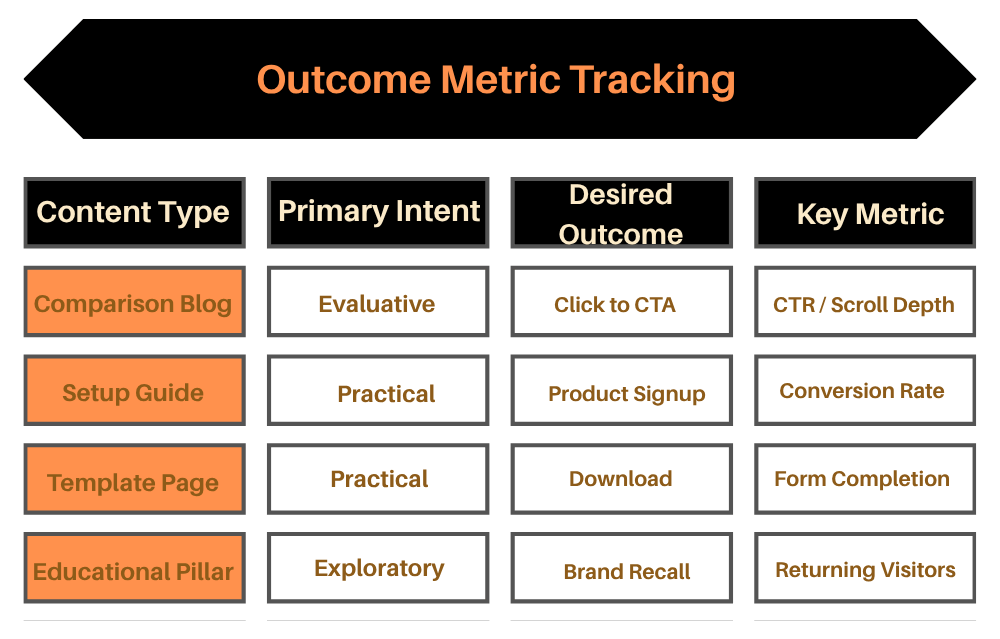
Smarter Competitor Analysis
Counting competitor backlinks, comparing DR, or keyword lists might give you surface-level insights, but it won’t show you why your competitors are outranking you. Now with intent SEO, it doesn’t matter what keywords your competitors are using, but how well they are satisfying search intent. Most marketers still make the same mistake. They open Ahrefs or Semrush, look for overlapping keywords, and call it a day. But what they miss are the deeper user intent layers. If you find the gaps in emotion, context, and completeness of the topic, you can tell the decent content apart from the dominant content. A smart SEO competitor analysis today means:- Using Ahrefs’ Content Gap by Intent to find out where your rivals fail to address key micro-intents.
- Exploring Semrush’s Topic Authority reports to see which brands own the conversation and which are just repeating phrases.
- Asking yourself: Do they answer why something matters, how to achieve it, and what comes next?
- Fill missing stages in the buyer’s journey with content that guides users to make a better decision.
- Create interactive content using calculators, templates, and tools that give readers a reason to stay longer and engage with your website.
- Add FAQ sections that clear up objections and capture long-tail searches.
Quick Checklist to Test Your Content Maturity
Here’s a quick checklist to see if your content is intentionally optimized or not.- Does each page solve one user task completely?
- Is there a clear next step (link or CTA)?
- Does your language use actionable verbs like compare, build, choose, or calculate?
- Is success measurable with a clear conversion metric?